Request support on coordination, information management, capacity development or other education in emergencies areas.
Demande de soutien en coordination, gestion de l’information, développement des capacités et autres domaines de l'éducation en situation d'urgence.
لطلب الدعم في مجال التنسيق ، إدارة المعلومات ، تنمية القدرات أو في اي مجال من مجالات التعليم في مناطق الطوارئ
Solicitar apoyo en coordinación, gestión de la información, desarrollo de capacidades u otra áreas en educación en emergencias.

The first half of 2025 has plunged the world into a period of profound uncertainty, and the global humanitarian system is being tested at every turn. For millions of children and youth, the consequences have been devastating: education is once again among the first casualties of crisis. Over the past few months, the Global Education Cluster (GEC) has been working with renewed resolve to bring affected voices to the forefront as we advocate for Education in Emergencies.
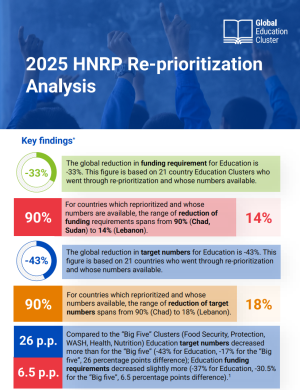
The GEC conducted an analysis across 21 Education Clusters to assess the impact of the re-prioritization process, revealing that funding requirements were reduced by 33% - and in some cases, by as much as 90% - amounting to higher reductions in education than in other sectors.
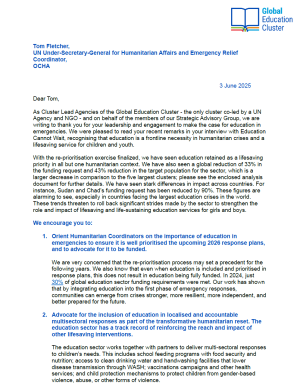
In a letter to Tom Fletcher, on behalf of the Strategic Advisory Group and Cluster Lead Agencies of the Global Education Cluster, we emphasized our collective commitment to education for crisis-affected children - not as a luxury that can be deferred, but a lifesaving necessity. In his response, he reaffirmed that education remains a priority in the Reset and calls for continued partnership to transform the sector and deliver for children.
Dear Abdurahman, dear Hazel,
Thanks for your letter and your commitment to Education in Emergencies, which is a vital lifeline for children and communities in crisis.
First, let me thank you and Education Cluster colleagues for your engagement in the Humanitarian Reset, from the extensive collective effort taken to deliver the hyper-prioritized Global Humanitarian Overview which we launched this week, through to your constructive engagement in discussions around Cluster streamlining and simplification.
As I said when we launched the hyper-prioritized GHO, this is a moment of reckoning. The unprecedented funding cuts we are enduring from donors have left us with no other option than to further reduce the number of people we are hoping to save, and we are left with the cruel math of doing less with less.
I know that you, in the Education Cluster, are feeling this acutely, and I know that the children you serve around the world are already hit by reductions in services. As you’ve rightly highlighted, education is a priority for nearly every child, and I want to reassure you that it is a priority of mine, as well.
Thank you for your analysis regarding how Education in Emergencies has fared in the hyper-prioritization effort. I appreciate the data you have shared and will continue to engage with humanitarian leaders to ensure that education is not neglected as we forge ahead with the Reset. I have been clear throughout this effort that our focus must be on delivering the most dignified and effective response to the most life-threatening needs, and I see safe schools and learning spaces for boys and girls caught in crisis as part of that effort.
However, I do want to be clear on one thing: the hyper-prioritization does not reduce what we are asking for, nor who we are targeting. The totality of our original GHO remains valid. Yet, with just 13 per cent of the funding we appealed for received, we must be clear-eyed. And in that context this hyper-prioritization presents the most critical aspects of our work, and calls on the world to enable us to deliver them. I am pleased to see education reflected even in this most ruthlessly prioritized version of our collective effort.
As we move forward, I count on your support to deliver a humanitarian response that is as streamlined and as multi-sectoral as possible. Know that I will continuously advocate for the right of children to education—and to the hope, safety, and opportunity for children and youth that this provides—even in the world’s gravest crises. I look forward to your continued leadership, partnership and engagement as we reshape our humanitarian response.
Tom Fletcher
Under-Secretary-General for Humanitarian Affairs and Emergency Relief Coordinator