Request support on coordination, information management, capacity development or other education in emergencies areas.
Demande de soutien en coordination, gestion de l’information, développement des capacités et autres domaines de l'éducation en situation d'urgence.
لطلب الدعم في مجال التنسيق ، إدارة المعلومات ، تنمية القدرات أو في اي مجال من مجالات التعليم في مناطق الطوارئ
Solicitar apoyo en coordinación, gestión de la información, desarrollo de capacidades u otra áreas en educación en emergencias.

An integrated education and child protection approach in Yemen is yielding positive results for conflict-affected children.
Coordinated by the Yemen Education Cluster, the education in emergencies (EiE) response aims to promote access to safe and protective learning environments, contribute to the physical and psychosocial well-being of children, and improve the resilience of the education systems to better cope with future shocks.
The state of education in Yemen
Yemen is the fifth largest internal displacement crisis in the world, with 4.8 million internally displaced persons (IDPs) including 1.6 million school-age children.
"Many children suffer from psychological distresses, affecting their conduct and overall well-being," explained an Al-Hajeb IDP site official in Maqbanah district, Taiz Governorate, where approximately 230 IDP families live due to the conflict. "This stemmed from their exposure to the violent and traumatic events of war, including the loss of lives".
There are acute challenges to education: schools suffer from overcrowded classrooms, lack of teacher training and 65 per cent of Yemeni teachers do not receive salaries or incentives. This results in interrupted learning for students and reduced retention in schools. Currently, 3.2 million children in Yemen are out of school.
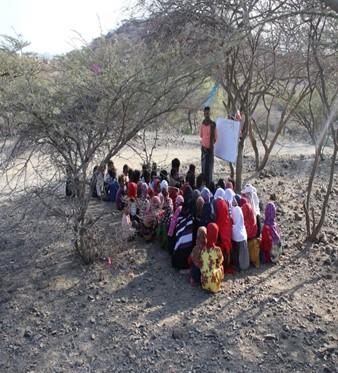
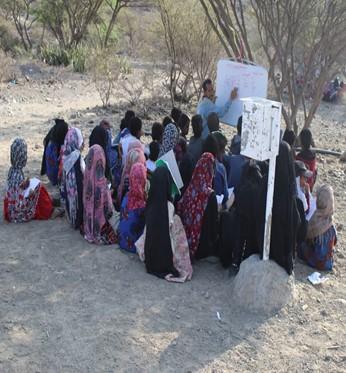
The Al-Hajeb IDP site has one school, Al-Anwar School, with only two classrooms and all volunteer teachers. The building originally accommodated only grades one and two, while students in grades three to five were forced to study outside under trees, exposed to varying weather conditions. With no proper classrooms, the students struggled to concentrate, often distracted by the discomfort of the heat, dust, and wind. The lack of basic facilities made learning difficult, adding to the mental distress they faced due to the conflict and displacement.
| 
|
Before the intervention, students in grades 3-5 at Al-Anwar school studied outside due to lack of classrooms.
"Many children suffer from psychological distresses, affecting their conduct and overall well-being. This stemmed from their exposure to the violent and traumatic events of war, including the loss of lives."
Coordinating the response
As part of its role to coordinate EiE in Yemen, the Yemen Education Cluster worked with donors and partners to mount a comprehensive response, integrating education, psychosocial and child protection approaches to tackle these challenges.
First, the Cluster identified needs through secondary data review and assessments, as well as OCHA-led area-based consultation workshops in the hubs and governates for key stakeholders. Results showed that additional challenges were inadequate water and sanitation facilities in schools, lack of textbooks and learning materials, and destroyed infrastructure.
The response sought address not only the education needs but also the child protection risks stemming from the education challenges, including increased school dropouts, early marriage, child labour and recruitment of children into armed forces. These risks also disproportionately affect children from marginalized communities, Muhamasheen, and displaced populations.
“The Cluster is uniquely placed to coordinate the response due to its vast networks of partners. It is able to work closely with all stakeholders on the ground to determine which interventions are most strategically relevant, accountable to populations, sustainable and cost-effective,” states Wail Shuaib Mohammed, Education Cluster Coordinator in Yemen. “Coordination ensures consistent standards are applied across the response and that targets are met with precision.”
Based on the priority geographical locations, the minimum package of interventions and standards to follow, and a technical review process of submitted proposals, the Cluster supported the Yemen Humanitarian Fund (YHD) to select and engage Bena Charity for Human Development (BCFHD) for the intervention.
Results
In line with the Cluster’s response framework and funded by YHD, BCFHD implemented an integrated education and child protection service package to vulnerable conflict-affected children in both displaced and host communities, in Maqbanah district.
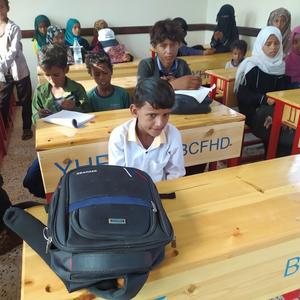
The project significantly improved the learning environment at Al-Anwar School by constructing three new classrooms and WASH facilities, complete with hygiene kits. The classrooms were furnished with new desks, whiteboards, lights, and fans powered by a solar energy system to ensure consistent lighting and ventilation. Volunteer teachers were also given teacher kits and eight rounds of cash incentives, while all students received school bags equipped with essential supplies.
Children received home-based MHPSS support that helped them navigate their grief, process their psychological distress, and build resilience so they could be fully present in school and focus on learning.
"We are grateful to YHF for this comprehensive intervention," said Abdulraham, the IDP site official. "It provided 379 vulnerable children with essential support by integrating education and child protection services, creating a safe learning environment, addressing emotional needs, and promoting resilience and overall well-being."
Al-Hajeb IDP site is one of 2,290 sites hosting a total 1.6 million Yemenis, including over 528,000 school age children who targeted with education interventions by the Yemen Education Cluster to ensure continuity of learning and build resilience against future shocks.
Going forward, the Cluster will target 1,890,424 children and teachers across 132 districts in 2025. Priority will be given to gender-sensitive interventions, unique challenges faced by displaced populations and access to inclusive education environments for children with disabilities.
Photos in text courtesy of BCFHD. Banner photo: © UNICEF/UNI496019/Hayyan
